When Inspiration Strikes…

Well, this past week was a good one for me.  This past week, I finished the first round of development on my latest brainchild.    Then, I was actually a little lost for a couple days, because I didn’t have anything urgent that I had to jump on, so I let my mind start to wander a bit.  I relaxed on Thursday and Friday, and then on Saturday, it hit me again.  I was trying to get my little guy to take nap, when inspiration hit me again.

So, why I am talking about this?  not to brag about my latest ideas (I’ll get to that in a future post 🙂 ).  No, I wanted to emphasize that when you can start to step away from the day to day work, you free your brain up to do the really valuable work.  Perry Marshall calls this the $1000/hr work.  The reality of the situation is that this idea might not have broken out of my subconscious if I had just jumped blindly to the next piece of minutia.  And believe me, in a small business, minutia can quickly rule your life.

What I would love for you to take away from this, is that it’s ok to be a little lost.  It’s ok to take a break from everything.  Give your imagination a chance to break free.  You’ll be pleasantly surprised with the results you end up with 🙂

Thanks for reading,

Delegating… Another Update

Well, since I’m still getting back into the swing of blogging consistently again (man, was that a mistake for me to stop.  ha ha ha), I thought I’d give you another update on something I’ve been trying to do.  In an attempt to remove myself from the equation of the person that does everything, I’m trying to delegate more stuff.  Now, this is incredibly difficult as a small business person used to doing everything.  It’s tough because there is no one to delegate things to unless you go out and find them.  It’s also incredibly difficult to let go of doing things I’m good at.

Both of these are excuses, and I know it.  But it doesn’t make it any easier.  Now, my first that I’m willing to start stepping away from is the day to day ABAP coding.  So I’ve gone through several different iterations.  First off, I reached out to some friends to see if they were interested in making some extra money.  Like everyone, they were interested, but what often happens is that life just gets in the way.  I don’t fault them at all.  If I was so damn addicted to my own business and seeing it succeed, I’m certain I’d be doing the same thing.  Now this isn’t to say that I won’t still get the chance to work with my first round of candidates…  but it did mean that I needed to keep hunting.

Lesson 1.  finding people willing to work on a fixed bid basis for programming is incredibly difficult.   There’s good reason behind this, but it doesn’t help my pocketbook :).  With programming, there are often unforeseen issues, poorly written specs, incomplete analysis, or just “weird” data that you thought you understood until you started to extracting it.  Any number of things can cause work load to go from 40 hours to 80 hours.  Most of the programmers doing this for a living and not a hobby (I count myself among the hobbyist) recognize this, and will only do it hourly.  So, I went onto ELance, and put a sample job out there.  It’s impressive how many responses I got to the job.  it was also interesting the rate ranges, and the approaches that I got with each.  I only found one person that gave me enough of a comfort level to try him out.  So far, the experiment has proved to be a success.  But, it did require an hourly rate.  The good news is that my programmer has done the homework upfront, so his estimates have been right on, or even under budget.  This is good on many levels.  First, it’s teaching me to write better specs each time.  Second, it gives me an outsiders perspective on my thoughts.  Finally, once we figure out exactly what’s involved, for the most part, I’m just spending a few minutes a day answer questions, and the rest of the time the code is being written without me.

Lesson 2.  Prioritization is key.  When I realized that I found my first consistent contractor, I had to figure out what was most important to me.  Now this should be easy, but I look at my extensive development list, what specs I currently have written, how attached to my own stuff i’ve become, well, let’s just say this took some effort.  The hardest part was letting go…  I have an idea that I really want to do, but I keep getting pulled away from it.  I even had a pretty solid spec written, and some of the work started.  But, since it’s my latest and greatest idea, I wanted to do it myself.  Well, I had to take a leap of faith and let it go.  I moved my work over to the dev box, and handed the spec over.  Again, it’s good because my idea is only getting better with another set of eyes.  But it was a bit of a challenge.

All and all, the experiment has been successful.  My next addition needs to be someone that can do ABAP Web Dynpro.  Otherwise I will end up doign all of that myself, or paying someone else to learn it.  Neither is the end of the world, but in the idea of delegating, looks like this is the next most logic place to go…  if you know anyone, or you’re interested, please ping me.  I have some simple things to get started on and we can do a trial of each other 🙂  Or, I’ll be happy to let you learn for a fixed bid project. 🙂

Thanks for reading,

Getting time back in your life… An Update

Well, a couple months back, my new guru, Perry Marshall, put the idea out there to unsubscribe ruthlessly from everything you don’t read in your inbox.  I just wanted to circle back to that post, and let you know how that went.

Now, for the first few weeks, it took me just as much time to keep unsubscribing from every little thing that kept popping into my inbox.  After about 2 weeks though, I did start to notice a difference.  I won’t lie, initially, I felt a little sad.  I didn’t have emails in my inbox to tell me I was important or someone was thinking about me 🙂  By the time I was doing this for a month, I was getting maybe 1 or 2 emails to unsubscribe from a week.  My inbox went from getting 30-50 junk emails a day, down to one or two.

Now, the real change came to my realization that the email inbox is NOT my top priority.  I don’t wake up first thing in the morning and check my inbox.  Instead, I just go about my daily routine of hanging out with the family, getting breakfast ready etc.  My inbox doesn’t get looked at for at least an hour or two after I wake up.  Now, this might sound like no big deal to you.  But just a few months ago, the first thing I did when I woke up was roll over, grab my phone and start deleting/reading emails.  Now, it’s something that I often forget to look at for several hours at a time.

IT’S FANTASTIC!!!  it is so freeing to not be addicted to my inbox, constantly checking for emails.  Just this one little trick not only bought me time back in my day, it taught me that the inbox isn’t my master.  Talk about a Win-Win.  Anyway, if you haven’t tried this experiment, just do it for 2 weeks.  It could change your life, and a minimum, it will at least buy you back a 1/2 hour of your day that you normally spend deleting junk 🙂

Thanks for reading,

Service Order ROI – Parts Planning

Well, it’s been a while since I started covering this topic, so I thought I’d get back to my series on the Return on investment for SAP Service Management.  if you missed some of the previous posts, be sure to check them out:

Notifications – Service Contracts 2

Notifications – Service Contracts 1

Notifications – Maintenance Plans

Notifications – Improve your products

Notifications – Measure Productivity

Notifications – Accurate Warranty Dates

Service Master Data – Is there an ROI?

I might get back to the notifications again soon, but today I wanted to talk about the service order.  I recently did a post talking about the concepts and practice of service parts staging.  Well, that got me thinking about the importance of parts planning within the service order.  Now everyone knows how important it is accurate forecast your inventory levels for production.  And while it’s still a bit of voodoo to figure out what you will really sell over a coming period, you at least have some idea of what to do.  And more importantly, you know exactly what components it takes to make one unit.

Well, service completely defies this logic.  In most places I’ve worked at, there is a “small” percentage of known maintenance coming.  This is often related to service contracts or maintenance plans.  It’s predictable and you know what’s going to happen.  If you want the generic example, oil changes for your car.  You sell a “plan” for discounted oil changes for 1 year, with up to 4 oil changes.  You know that you need to plan for the oil, filter and technician time.  No problem.  You still don’t really know exactly when it will happen, but you at least can guess.  But the real bulk of most service is unplanned and unpredictable.  You hope you’re product is designed to last at least a certain time period without a failure.  But things happen.  The point is, since you have no idea what could go wrong, how do you plan for this???

This is where your service order (and to some extent you service notification) become invaluable for helping you develop your own crystal ball of potential repairs.  Your service order should always contain the material that is being repaired (that’s a given).  But if you are using it correctly, you are also loading up all the time and materials you used for the repair.  This is normally driven from a cost perspective.  But what many people don’t realize is this is building your history, if you just remember to look at it.

I’m hoping the light bulb is starting to go off out there, but if not, let me lead you a little further down the path.  If you start looking at the components used for a particular repair for a material, it’s likely a pattern will emerge.  So let’s say you have you widget, and there are components 1 – 20 used to build it.  Now, if I were to pull every service order for the past year for that widget, and analyze the components (and qty) issued to those jobs, in most instances you should see the pattern of common parts usage.  Typically there will always be the common wear components (in your car this is the oil filter, air filter, brake pads, etc…)  Things you know will wear out and need to be replaced.  But now if I take this one step further, I can start looking at the average time before these components needs to be replaced.  Now, this analysis is a lot harder, because now you need to take into account the date the components was added to the widget (this could be the production date, or it could be the last service date).  However, the information is all in SAP.

Now, let’s just step back for a second.  Knowing exactly how long a component will last is great to know…  but for our purposes, this might be more info than we need.  If we can simply look at the component usage for service over a time span, we can now “forecast” what we really need to keep in stock in order to turn around those customer issues as quickly as possible, while still maintaining minimum stock levels.  Now if you’re already doing this, my hat is off to you.  In general, I don’t see this happen in the service order very often.  For the rest of you, if you’re looking for a tool to help you get this information, check out the Renovation Service Management Dashboard.  We are currently adding several new sets of metrics/reports to this dashboard, including service component usage.  If you could use this information, we’d love to help.

Thanks for reading,
Having a Bad Day…

Have you ever got an email or a phone call that manages to haunt you all day long?  I recently had one of those experiences, and in retrospect it’s making me angry that I let it mess up an entire day.  There will always be things that just slap you in the face.  What it all comes down to is how you deal with it.

If you let that conversation replay over and over in your head, then you relive that anger, frustration, pain or whatever feeling you felt over and and over.  Essentially building in your mind those bad feelings 10 fold.  So…  now how do you reverse that???

I’m certainly no expert, but I’m finding that I just deal with it, and move on.  But to dealing with it, can be a pretty vague task.  For example, you don’t want to tell the person off, because often it’s a misunderstanding, so you need to deal with it appropriately.  A couple of things tend to help…  it’s not foolproof by any means, so if you have a suggestion, I’d love to hear it.  But in the meantime, here’s what i do…

1.  Take a walk and listen to some of my favorite music or podcast.  It helps me shift my focus away from the event and take a fresh perspective.

2.  Write a blog post.  Sometimes for me, writing is my venting.  Once I get it down on screen, it helps me move past it.

3.  Play with my kids.  This is always a winner, even if I’m having a good day.  For example, I ended the day watching a 1/2 hour of Star Wars with my favorite little man.

I’d love to hear how you handle a situation like this.

Thanks for reading,

Lesson Learned…

Well, perhaps you’ve noticed I’ve been on a bit of a hiatus lately.  There were multiple reasons (borderline excuses, I admit :)).  It’s summer, so like everyone, there are always extra things going on, and I also had aspirations to do weekly “BIG” posts, rather than daily posts.

Well, what I found is that distributing the time into one big post, turned into an easy way to not do it at all.  So, the lesson learned for me is that staying consistent works so much better for me, than trying to one big post.  In general, I think this means that I might do more “series” going forward.  This will give me the big posts, but still force me to stay on track.

anyway, I wanted to apologize for my lack of posts.  It’ll take me a week or two to get back into swing, but I plan to be posting more 🙂  Stay tuned, and as always, if there’s something you’d like to hear about, please let me know.

Thanks for reading,

Service Management – Service Parts Staging

It’s interesting, because as long as I’ve been doing service, I’ve always tended to be hands off on this portion of the process.  I left it to the MM or WM person to set this up.  I won’t pretend to be an expert or go deep into the configuration, but the overall process is something i wanted share.  Let’s start at the beginning.  What am I talking about when I say service parts staging?  I’m talking about the process of getting components that will be used in a repair to the service storage location so they can be easily issued to the order upon completion.  It also serves to “secure” the inventor for service.

Now, several of the things I just said, require a little more explanation, and I’ll get to them to shortly.  First, I need to digress a little and explain the 3 most common scenarios for service inventory.

1.  Service uses it’s own IM managed storage location.  Any additional inventory is acquired from an IM managed warehouse.  This scenario is the most common and the most straight forward.  Inventory can be completely managed using material movements.

2.  Service uses it’ own IM managed storage location.  Any additional inventory is acquired from a WM managed warehouse.  This is somewhat common, but still happens in the minority of facilities.  In general, WM tends to be used only for large warehouse with a large number of components.  This scenario becomes much for complicated because any time you deal with a “mixed” environment, you have to deal with material movements, transfer requirements and transfer orders.

3.  Service exists in the same WM warehouse as the inventory it may need.  While this sounds like an easy environment, it’s still a bit of a challenge because service management has no integration with warehouse management.  Now production orders can integrate with WM cleanly (at least in this scenario).

Now, the heart of the issue come from getting the parts to the service order when it’s needed.  This inevitably means that service will need stock from somewhere else.  It really doesn’t matter which of the 3 scenarios you are talking about, each presents it’s own set of challenges.  At the end of the day, we just need components in a location that the service department can access them.

Now, let’s take scenario 1 & 2 together.  let’s say we have a storage location called SERV. This will be the SLOC that service uses.  Now, the inventory that service and production both use will be in a SLOC called INVN. Now for your service parts, at the end of the day, it doesn’t matter if INVN is IM or WM.  To get the parts, you need to execute a material movement, like 311, and then send the pick list over to the warehouse to pick the parts and deliver them.  If INVN is Warehouse managed, just doing the 311 movement will generate a negative that can be converted to a TR/TO to actually move the parts from the bins of your choosing using LB12 or some other variation to create the .  Now, the major challenge is creating the material list to transfer, and then of course performing the actual move.  Now, the good news is that the components are “reserved” because in SAP they have moved to SERV, however the physical move still needs to happen, so it’s important to make sure the pick list gets sent to the warehouse to complete the loop when using the 311 method in advance.

Scenario 3 is actually quite a bit easier.  Since it is completely within WM, SAP provides a transaction called LP10, that allows you enter in the order and then select what bins to pull the material from, and then deliver it to appropriate service order.

As you can see, getting components to the service order isn’t as easy as it looks.  There is significant work, and this should play an important part in your blueprinting for service.  Determining if you want to deal with WM or IM in your service area is an important consideration.

Thanks for reading,

Variant Configuration – Unit Testing the model

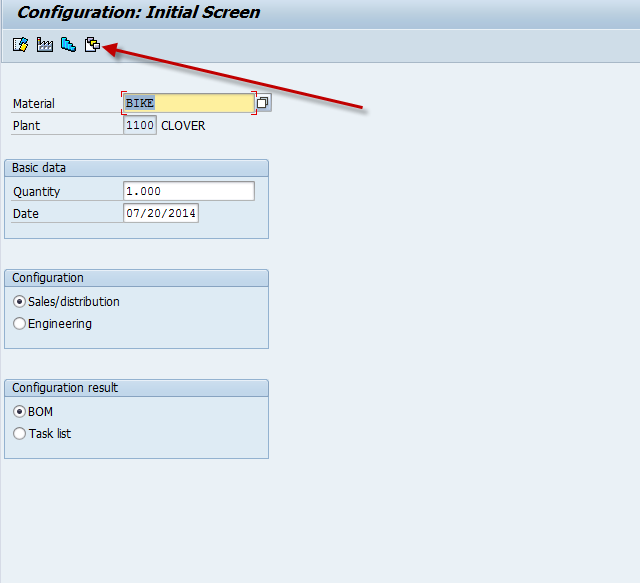
Well, it recently came to my attention that when it comes to testing a model, it might not be obvious to everyone some of the cool tools available within in CU50.  While the seasoned veteran may find this obvious, as you learn VC there are always tricks that can make your life easier.  Today’s post is no exception.  Today we’re going to talk about the configured objects button with in CU50.  I’ll confess, this was a button that I knew little about for some time.  But of late, this has become one of the most useful testing tools when sales orders/production orders are generated.

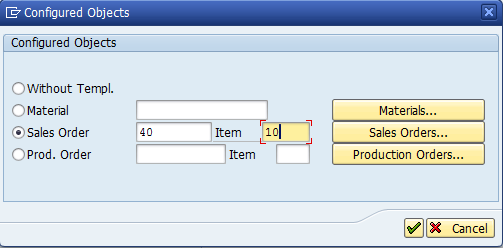
blog02-01

Now, if you don’t recognize the name of the button, this screenshot should refresh your memory, even if you never knew what the button did :).

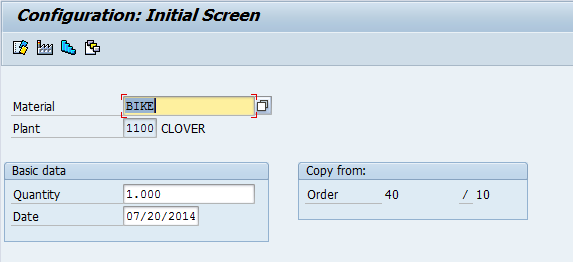
blog02-02

Now, this little feature is outstanding.  You can enter in a sales order or production order (material is for material variants, but you don’t need to enter this screen to see those.).  By entering this information into this screen, CU50 will bring in the complete configuration from the document, in this instance the sales order.

blog02-03

As soon as you hit enter, the standard CU50 screen will return, but you now get an extra Copy from: section to show you exactly what you’re copying from.

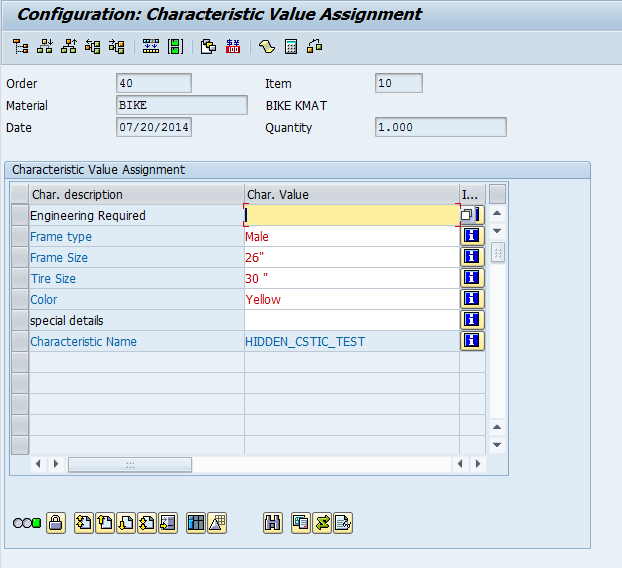
blog02-04

Once you enter the configuration screen, you can see all the characteristic values populated.  Now, this is especially valuable when dealing with sales relevant and production relevant items in the same BOM.  You also have the ability to see the configured routing.

While you can see bits and pieces by looking at the sales order, you often must see both a sales order and production order to see the entire picture.  CU50 gives you everything, and now you don’t even need to copy each and every value.

Hope you find this valuable and thanks for reading,


Quality over Quantity… Time for a Change

Well, a friend of mine recently sent me an article.  The basic idea behind it is for blogging, is it better to do high quantity?  or high quality?  In a perfect world, it would be both.  But let’s face it.  Most of us don’t get paid to blog.  It’s something we do in our “spare” time.  For me, it’s generate awareness of what I do, increase credibility, and maybe even attract a potential customer for my products.  That being said, I’m going to switch things up.  I’ve been doing posts Mon – Thursday for a past couple years.  Initially, I had a lot to talk about, and numerous topics to discuss.  Lately, I’ve noticed that many of my posts are just to post something.  I’m trying so hard to put out 4 topics in a week, that I don’t have the time to make them in depth, or really valuable.

After talking with my good friend Justin, I came to the realization, that if I spent the time writing one good post a week (at least that’s the initial plan), that it would be far more valuable than writing 4 posts, and would take me the same amount of time.  So to my loyal readers who look forward to my daily words of wisdom. (ha ha), I hope you’ll stick with me through this transition, and i welcome your feedback.  I do promise, that as I learn little tips or tricks, I’ll still drop in a quick post about them, but in general, I’m going to strive for greater quality, which means that it will be a lower quantity.

Thanks for reading,

Linked-In Using all those connections

Well, I signed up a few months ago with a company to help expand my linked-in presence.  They have done a great job of increasing the number of times someone searches me, as well as getting me connected to a vast number of a people.  The problem is that I now of all of these connections…  but what do I do with them?

The concept is that I can eventually get quality through quantity.  A theory that seems sounds.  However, with all that quantity, comes a great deal of “noise”.  The idea behind increasing my linked-in connections was to get me connected to people/companies using SAP.  In particular, to help me connect with the decision makers and the people that can write the checks.  Well, right now, I have no good way sort through the people that I may want to speak directly with.  I did recently find a cool option that I didn’t know about, and that is the option to tag contacts.  This is great, if my contacts had been “tagged as I went”.  Now, the shear volume would take me days to get through to tag everyone.

So, what I will likely end up doing, is searching my companies that I know run SAP.  Then for each of my first connections, I can go through and tag them.  The problem with this approach is that it still leaves all the companies I’m not aware of, thus losing me the connections I was really looking…  But like everything, I need to start somewhere.

But, if you’re connections are manageable, and you are trying to use Linked-In for business connections, the tag is a good option.  If you might have any suggestions on how to better sort my connections, I’d love to hear it.  In general, I’m a linked-in novice, so any advice is greatly appreciated.

Thanks for reading,

Posts navigation

1 2 3 52 53 54 55 56 57 58 96 97 98
Scroll to top