Free Time – How do you use it?

Just recently, my wife told me something that kind of made me angry at first, until I stopped to thinking about it.  We were talking and she told me she likes to spend her free time being active, I like to spend my time on my computer.  At first I got defensive…  I like being active too, but I just don’t have the time.  But I stopped to think about it, I do have the time, but my priority is my business.  It isn’t a matter of what I like to do… it’s more a matter of what I need to do.

One of my favorite gurus, Brian Tracy said in one of his programs that in order to succeed, you need to be working while everyone is sleeping or playing or watching TV.  I guess I took that heart, maybe a little too well.  My goal is to launch my software business so that I can do what I want, and be here with my family, not traveling to the client site every week.  So, with that one end goal in mind, I guess I’ve chosen to make my business my free time.  Which I have to say, isn’t a whole lot of time anymore, now that I have 2 kids.  ha ha ha.

The whole point is that your free time can be fun, it can be productive, or if you’re really lucky, it can be both at the same time.  =)  I don’t know if I’m quite there yet…  but the result will be worth the price when it all comes together.  So if you’re like me…  just keep that goal in mind.

Thanks for reading,

Challenges of Updating the Website

Well, for those of you who’ve read me my stuff for a while, know that my website hasn’t really changed in a while.  Well, we used the exact setup for the JaveLLin Solutions website as well.  I was able to transistion this over to my partner to run (I still have to write my own content…  but at least he’s handling the day to day stuff).  Well, he wanted to update our look, so I said ok.  We purchased Optimize Press, and he started playing.  Like anything, it’s a big ramp up period, so he found someone that was willing to help on their off time for an hourly rate (don’t get me started on this one).

Well, I thought great…  I have a ton of content out there on the web, so it should be more than enough for someone to chunk it up, shuffle it around, make it look better, make it sound better, etc…  Damn, was I wrong on that.  As it turned out, it was nearly as much work to have someone else come in.  Even though the concepts of SM are second nature to me, when a complete SAP outsider looks at the data, it’s pretty much jibberish to them.  So, I spent a lot of time re-writing my own content.  In the end, will it be a better product?  probably?  do I feel it was worth the huge investment of my time and our limited business capital, not at all.

What’s the lesson for today…  there’s a couple that i leanred.
1.  For anything like this, do NOT do an hourly engagement.  The person Mike picked didn’t know SAP & didn’t know Optimize Press.  This turned out to waste a lot of time, and in essence, we paid for them to learn a new skill.
2.  Make sure who ever you outsource this to has at least MOST of the knowledge you need.  Like i just mentioned, no SAP knowledge, and no Optimize Press knowledge made things go a lot slower and cost a lot more.  It also increased the amount of time Mike and I had to invest in rewriting our own content, or bringing back content that was trimmed out, but was very important to the message.
3.  Make sure the contractor understands what you really care about.  And even more important, make sure everyone is on the same page of what needs to happen.  For example, my big hot button was to get some template pages setup, so we could just plug and play our content.  And I wanted landing pages to direct people to for our new White Papers.  Mike was interested in changing the whole look and feel.  Not that I was against this…  but it wasn’t my priority.  Anyway, get on the same page before you do anything.

Good luck and thanks for reading,

ABAP – Creating an RFC

Now, in one of my many latest endeavors, I need to create RFC’s to port my code out to an Iphone/Ipad application.  Happily, we have a great contact that is helping me with this stuff.  Now, I knew this was coming, so at least I put the majority of my code into objects/methods.  This makes moving the code pretty simple.  however, I still needed to add a new wrapper to an existing object.

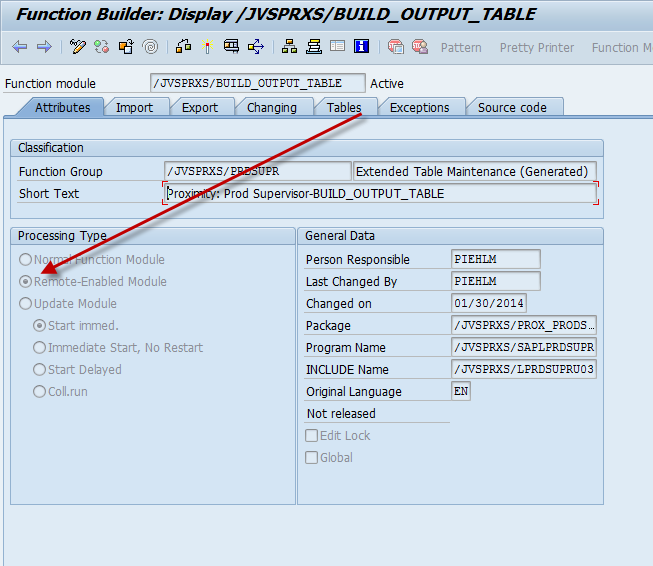
So I go to SE37, create myself a function.  Under attributes there is one major piece to turn on:

blog02

Set this flag, and you’re good to go.  Now, I have run into a small little obstacle that I have yet to overcome.  I’m using the Netweaver gateway to port my code to the application.  Initially, I had set a bunch of tables (so it would like a select option).  For some reason, we were unable to get the information to be sent to through the gateway like this.  When we moved it to be a straight exporting parameter, everything worked fine.

So, if you happen to be someone that knows NW Gateway, is there a trick to send in information as an input table?  and still have the information sent through the gateway?  I’m sure it’s something dumb that I missed, so any feedback you might have, please post a comment.

Thanks for reading,

ABAP – SELECT vs. SELECT INTO CORRESPONDING FIELDS OF TABLE

Well, it turns out my new system is teaching me all sorts of things lately.  Today, I learned the value of how to code the select statement.  In my old ERP 6.0 SR3 system, I built a small program to make notifications in my system.  I use it to generate master data to test my dashboard.  Well, the statement worked just fine so I didn’t think anything of it.

Select equnr from VIQMEL into lv_equnrfor all entries in lt_equip
where equnr = lt_equip-equnr and

kzloesch = ” and
owner = ‘4’.
… do something here.
Endselect.

The statement seemed harmless enough…  until I went to load this into my new EHP4 system.  It has the upgraded kernel, latest support packs, blah blah blah.  It suddenly when a minute, to hours to execute this same piece of code.  I still don’t know exactly what changed…  but sure as hell, my code changed 🙂

I moved to:

select equnr from viqmel into corresponding fields of table lt_qmelwhere equnr = lt_equip-equnr and
kzloesch = ” and
owner = ‘4’.
loop at lt_equip into wa_equip.
read table lt_qmel into wa_qmel with key equnr = wa_equip-equnr.
if sy-subrc = 0.
… do something…
endif.
endloop.

this dropped it make into the less than a minute to read the new code.  wow.  I don’t know what caused the issue, maybe it was 7.01 vs. 7.00, but the same table read in a slightly different way made a huge difference in this program.
Thanks for reading,

A little memory goes a long way

Well, in my latest experiment with making a new SAP system, I found out the value of RAM in the system.  Now, I already knew that more was better, but I guess I couldn’t really quantify it until this past week.  I started building my system on my laptop, while I was waiting for the new server to arrive.  No big deal, my laptop had 16GB of memory, so I allocated 6GB to my virtual machine.  I had my system on a USB 3.0 HDD (this part is important later) and I installed a bunch of support packs (probably around 50-60).  I had the job running, and it went for nearly 48 hours.  Not terrible.  The problem came when I left my machine within reach of my newly climbing baby girl.  She managed to pull herself up the small table my laptop was sitting at, and yank on the USB cable.  Ouch…  3 days of work down the drain.

So, having learned the hard way yet again, I moved the system to my new server.  It was finally ready and properly set up.  Since I had a lot more memory available, I bumped this system up to 10GB.  Luckily, I remembered the steps I had done the first time around, so the setup to install went much faster.  When I kicked off the support packs, I was able to finish the job in roughly 18hours.  I then installed another dozen or so, ran SGEN, and the whole process took 48hrs.

So, just a word to anyone out there with their own systems, more memory really makes a huge difference 🙂

Thanks for reading,

Getting that new system ready to roll

I apologize to all of you out there for not getting back to the warranty claims thing.  I do intend to get back to that line of posts, including more in depth configuration, but my time has been consumed in the infrastructure world of late.  Namely, building myself a new virtual server box that can be used for testing.  This all sounds pretty easy, but believe me, it’s been far more time consuming than I imagined.  My only saving grace is that I blogged a lot tricks a while back that have helped me out of a jam.  So today, I wanted to talk about the high level steps it takes to build a new system, using virtual server.

Now, virtualbox is my virtual server system of choice, and I love it.  It’s been good.  One of the things I love about it is the clone feature.  It allows me to take a previous snapshot or current state and convert that into a brand new system.  That’s what I’m doing now.  I had an ERP 6.0 EHP4 system I’ve been using for development, and now I need one for testing.  I thought I had one…  but that’s a long story 🙂  Anyway, I chose to clone a snapshot of the EHP4 system before any development work was done.  This gave me a good starting point (side note, be careful if you clone a system, then delete it, then try to clone it again.  I had a lot of trouble making that work with virtualbox).

Now, once I had my cloned system, it needed a lot of work.  First and foremost, it was built on a windows platform, so I needed to get all the updates installed.  If you use windows, you know that there are a LOT of updates, especially going back almost 2 years.  ha ha ha.The next thing I needed to do is move all of the configuration transports back onto this box.  Now a huge deal, but had to wait a while for dropbox to re-synch in order to get everything available, and then one by one, import and install each transport.  Next, I need this to be it’s own instance number.  Good thing I did a post on that a while ago to remind me of all the steps to do this.  However, I was running into issues making it work, so I needed to upgrade the kernel first.  Again, good thing I had a post on that too 🙂  Then I thought… well, I should be on Kernel 720, so I upgraded that too.  So far so good, but suffice it to say, none of these steps are quick.  Now, I want to have this system up to date on all the support packs, particularly related to Web Dynpro, to make sure it can run on as many browsers as possible for testing.  I can’t believe how long this takes.  It’s been running for nearly 2 days.  I guess that’s what happens when you’re 9 – 15 levels down.  Oops.  Anyway, once this finally finishes, I can run SGEN to compile all the changes and take a virtualbox snapshot.  Then I’m finally ready.  (of cource… the next mission will be to create another system with Netweaver 7.3.  I’m sure there will be posts on that soon).

As always, thanks for reading,
Blogging for Business

Well, if you’ve been reading me for any length of time, I’m sure you know that I started this whole blog initiative because of some marketing stuff that I listened to and followed for a while.  I learned some good stuff from it, but most of it I’ve since left behind, because a lot of the concepts were geared toward selling things on the web.  If you know anything about SAP, it’s not the sort of things that someone is going to whip out a credit card and buy (unless it’s an e-book).  But the blogging thing I’ve stuck with.  It’s been around 18 months that I’ve been doing it hardcore.  I really didn’t expect it to last this long.  Some days it’s a royal pain trying to figure out what I’m going to write about next.  Other days, I know what I can write about, I just don’t have the time to pull the screen shots and do some real in depth configuration, but to quote one of my little boy’s favorite movies, I “just keep swimming”.

The crossroads I’m at is this.  I was under the impression that blogging good content increases your SEO ranking and helps to promote you in organic search.  I am far from understanding much about SEO, but I have been learning enough to know that if you stick with it long enough, it can be “free” publicity straight from google.  Now, the question comes down to where I want to promote.  Perhaps some one out there can give me some guidance on this…  I have two business, my consulting business that I”m trying to move away from, and my software business that I’m trying to move toward.  Our website is undergoing a major revamp and I hope you’ll all check it out when it’s finished.  My partner and I are in different camps on where to blog.  Do we each keep a separate site and blog in our own ways, and periodically blog at Javellin?  Do we both blog at Javellin exclusively?  or do we copy selected content from our own blogs and post it on Javellin?

Now, I was ready to push everything of mine to the new site, in hopes of generating better SEO for the real business.  My partner is worried about losing our content and thinks it better to just link back to it, or “move” selected blogs to Javellin.  anyone out there know the right answer to this?  Am I worried about nothing?  If content is duplicated, do you get punished by google?  is linking a blog to a website help organic search at all?  Guess I’m wondering if any web guru’s out there might know the answer.

Sorry for not being more informative…  today is a question day to y’all.

Thanks for reading,

Hardware Headaches

Well, like always, my life is full of fun little twists and turns.  We have our upcoming MFG conference in Vegas coming up.  Some of the cool things we are looking to do include a Proximity Web Dynpro Application and a mobile app.  Well, the problem is that we needed a new server to run a couple more systems.  Namely, systems new enough to handle web dynpro on any browser and mobility.  So, as CTO, I needed to get myself a new server.

Well, it’s a nice one, 32GB of memory, 3TB HDD, etc.  Well, I waited for a while and it finally showed up.  I was like a kid at Christmas.  I quickly ran up to my office and started to get it up and running.  Well, things were rolling along, I got dropbox installed, norton, virtual box and the like.  Then spent 3 hours copying 500GB of data to start my new system.  I even created a new clone system and start to get that started.   So after a full day of working, I was feeling pretty good about myself.  I got up the next morning, and suddenly the system wouldn’t fire up.  I tried playing with BIO’s, rebooting, unplugging all the usb drives etc…  still no love.  I come to find that Windows 7 professional has issues with drives bigger than 2TB.  I was a bit perturbed…  especially since the company I bought this from specializing in upgrading systems.

So, after a full day of work, the only choice I had to use the emergency disks and install Windows 8.  Well, learned my lessons…  first, be careful letting your hardware exceed your software, second, don’t believe that a company knows everything.

Thanks for reading,

ABAP Web Dynpro – Setting ALV Column Header

Not that long ago, I discovered the whole world of ALV tables within ABAP Web Dynpro. As is so common for me, I’m still figuring out all the ins and outs of the code. I have done several tables in my first application, and they all went pretty straightforward. Suddenly, I went a little off the norm, and the column text that I was using stopped working. So because of that, I wanted to make sure I shared this little tidbit about setting the ALV Column Headers. I did a post on this stuff, but I missed a key element. If you’re looking for explanation, take a look at this post.

        ls_col_hdr = ls_cols-r_column->get_header( ).         ls_col_hdr->set_ddic_binding_field( if_salv_wd_c_column_settings=>ddic_bind_none ).         ls_col_hdr->set_text( ‘R’ ).

Now, the important thing to notice is the 2nd line I have listed above. In certain instances, no matter what you try, you can’t undo this binding. So, when in doubt, explicitly break the link. it’ll save you a lot of headaches 🙂

Thanks for reading,

Variant Configuration – Adding Values to a Multiple Value Characteristic in use

Now, this is an obscure, so no idea if anyone else has had to do this, but I just had a situation where a multiple value characteristic started off as free text only and the client needed to change it to define the values.  I thought this would be a simple exercise, however I quickly found out a few things.  If your characteristic is in use and you choose not to check the additional values box, then it’s all or nothing before you can save.  That means you need to track down every value that was entered for you multiple value characteristic and give it a value in CT04.
Now, I went through the where used and thought I found every value that I had used.  Well, I was wrong.  So, after spending a little time in debug, I found the following trick.  If you place a breakpoint in the following area, you

Program: SAPLCTMV
Include: LCTMVF2I
Form: CHECK_DEL_OF_VALUE

Function: CTCH_CHECK_CLASSIFICATION

If you place a breakpoint here, and look right after this function, you’ll see a couple of error lines.  If you look at the value of  sy-msgv1, you’ll see the value that is missing in your characteristic.  Now, this is probably an iterative process to get everything, but this will help to prevent you from wasting too much time looking for one specific value to add to your characteristic.

Thanks for reading,

Posts navigation

1 2 3 62 63 64 65 66 67 68 97 98 99
Scroll to top