Variant Configuration – Material Variants Visible in Sales Orders

I just discovered something interesting that I never noticed before.  During some testing for an upcoming go-live, one of the people in our team noticed that in an plant that uses the material variant, but doesn’t produce it, you can see the configuration within the sales order.  The configuration is completely grayed out, so no changes can occur, but still behavior I didn’t realize.

This little tidbit has some interesting side effects and possible benefits.  The first and most obvious is that your order entry person can easily see the configuration of a material variant if they want to see what options are select.  Now, one of the key things to keep in mind, if you want this behavior, you now need to maintain the characteristics and values in all plants.  This is always a mixed bag in my opinion.  Typically, I encourage clients to only maintain the material variants in plants that produce the material.  The reason is that for any changes to VC logic that impacts the characteristics and values needs to be updated in every material variant/plant combination.  This can quickly become a big data nightmare if you have many plants and variants.  If the number is manageable, it’s not such a big deal, but it is an extra piece of data to maintain.  It also means that you need to be careful if you need to have any plant specific logic incorporated within your materials (again, you hope to avoid this whenever possible in the model).

The short story, it could be a mixed blessing to have Material Variant information available within the sales order.  Potentially valuable, with master data maintenance repercussions 🙂

Thanks, for reading,
Motivation – Avoiding the Letdown after a big event

Well, right now, I’m struggling a bit with keeping my high energy going after the big conference.  It’s now been over a week since I got back from Vegas.  The conference was great, we got a lot of solid leads…  but with so much work going into the conference, it can be hard not to slack off a bit.

So, leading up the conference, I was focused on getting the website converted to our new format (check out www.JaveLLinsolutions.com and let me if you have any feedback on the new site), and I was focused on a web dynpro version of Production Execution, and the IPad app for the Production supervisor, getting a new SAP system up and running to allow fast access of all our applications…  All of that effort, kinda left me a little burned out.  Then of course, I’m a bit of an introvert, so having to be on 100% of time during the show really takes a lot out of me.

So, what I’ve found is that it’s quite alright to take a week and ease back into things.  Go to bed at a reasonable hour every night, just work till you get tired, or take care of the high priority tasks, and let the secondary tasks slide for a week.  the important thing to remember is that you can’t let things slide forever…  so keep your to-do list up and running.  Focus on the high priority tasks, and when you feel a little more charged up, go back to your “normal” schedule.  For me, I’m hoping to ramp up this coming week and be rolling at 100%.  The conference gave me some big new things to start working on, but I need to start small.  I also just finished a great marketing book.  I’ll talk more about that soon…

Have no fear, more technical stuff is coming, it’s just been a long couple of months.  ha ha ha.

Thanks for reading,

Marketing – Updating the Autoresponder

Well, I just recently spent a few nights updating my existing auto-responder course for Service Management.  I thought it would be a quick win.  Afterall, I was trimming out most of the lessons that no one looked at anyway.  Well, it turns out, that I need to pay more attention to the auto-responder than I have in the past.  Let me walk you through what needed to happen.

First, I copied all the existing web pages to a word document, so it would be easier to edit offline.  Crazy, but this is a lot more effort than I originally expected.  I needed to do it anyway, so I could grab a lot of the content that will become a series of E-Books anyway, but sometimes just pulling images from the webpage is a major hassle.

Once I had everything in word, then it was proofreading, updating the content to sell better.  Namely, trying to pitch this more a higher level audience.  Like I mentioned in previous posts, most of my stuff was geared toward my peers.  Great to build my reputation, not so great to generate sales 🙂  So that meant I needed to rework much of my content, remove the low level configuration.

After finishing all that, I needed to update all my web pages (my auto-responders all link back to web pages in my site).  The reason I do this is to see how many people are interested enough to open the email, and then how many click to my site to read the whole deal.  It helps me gauge how good my copy is to entice people to read the whole thing.  Then, of course, I ran into a new obstacle.  Using Optimize press meant that I lost all the good looking formatting for my class.  So I needed to recreate each page, just to have a logo, title bar, etc…

When I finally finished all that fiasco, then I had to head back into Mailchimp and rework all that content.  Mostly easy, but then I realized that the extra content I had in my surrounding my teaser copy.  So I had to make sure that each of my pages was consistent and accurate.  Especially since we’ve rebranded some of our products.  Short story, just re-tooling my auto-responder burned a good 25 hours when everything was done.

So, with all of that, if you want to check out the finished product, I’d love to have you sign up 🙂

href=”http://eepurl.com/qlF91

Thanks for reading,

New Trends – SAP invests in Field Service

While initially, I was afraid this might be bad for me, it’s anything but.  The trend that SAP is working toward is all CRM Service Centric.  While this may be the latest and greatest, our target audience is still the small to midsized companies.  Many of them don’t have the resources to switch to CRM service.  This works perfect for me.  My self service portal can be a perfect compliment to the portal SAP has for CRM, and likewise, the Field Service application I’m currently building will do the same thing for SAP’s app that works off of the cloud/CRM.

I saw a presentation that went over the whole range of stuff that SAP is working on/just released in regards to mobile apps, web apps, and let me tell you, it got me excited.  Especially, if I can capitalize on this trend.  So, watch for more posts on the future Field Service application from JaveLLin, I’m already hyped up about it 🙂

thanks for reading,

The difference a year can Make – our Tradeshow evolution

Well, year 2 at the SAP Logistics/SCM/MFG conference was a dramatic improvement.  Some of the key things we found.

1. Swag – you have to do it.  Despite the ethics of “I only want people to talk to me if they are interested in my solutions”.  It turns out this approach is an epic fail.  By having slinkies and bags, we instantly had people stopping by, and would talk to us, sometimes finding they did have a need.  At a bare minimum, it gave us an opening to talk to people.

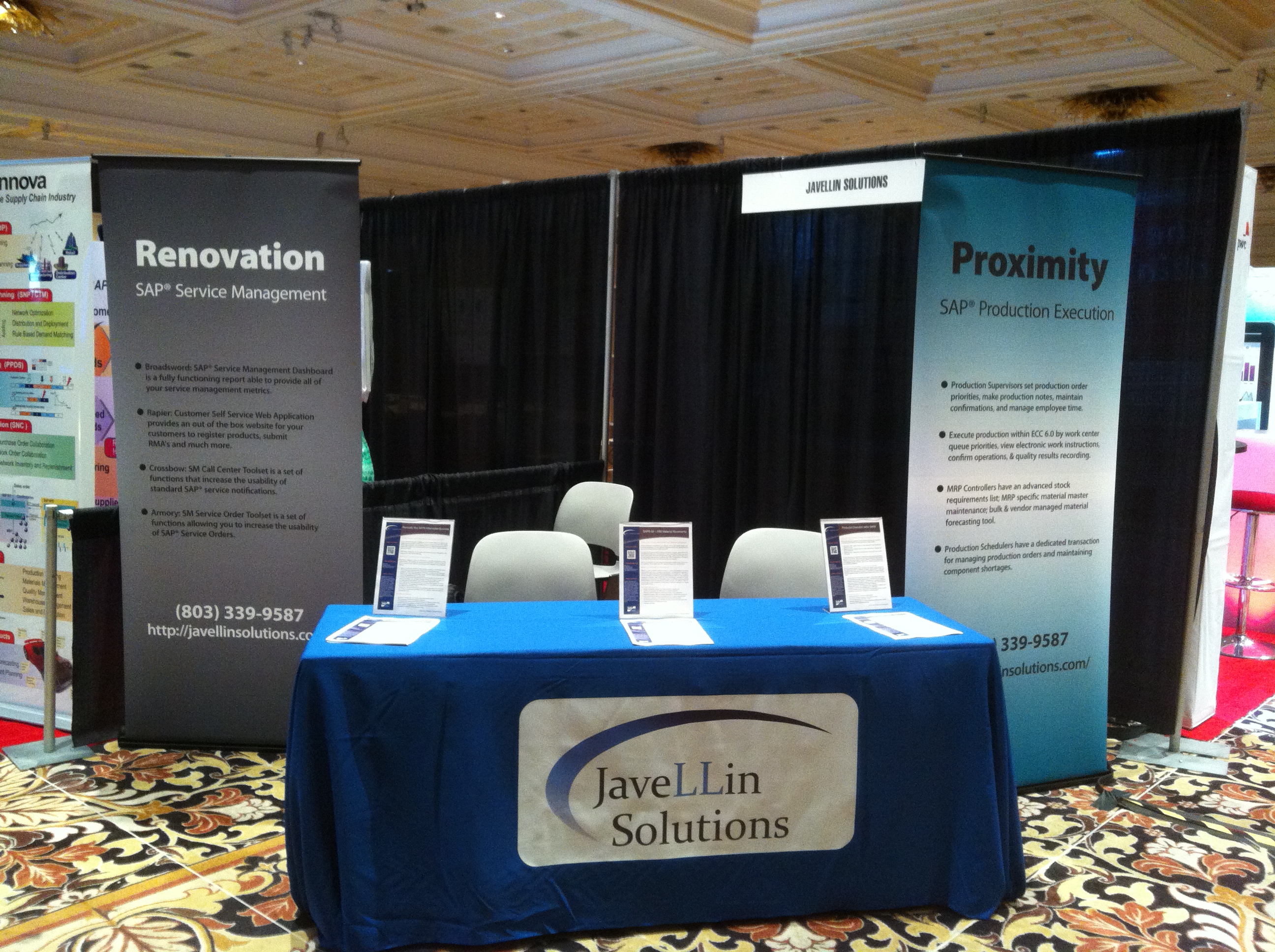
2. A real booth makes all the difference – Take a look at my last post to see the before and after.  Let’s just say, looking real gives people a lot more security in your solution.

3.  Having people.  Last year, Mike and I did it all ourselves.  This year, we brought 3 extra people, and let me tell you, it made all the difference in the world, especially during the busy times.

4.  Location, location, location – it’s just like real estate.  Mike ended up picking one of the best spots in in the tradeshow.  We ended up on a corner, facing a pair of rooms used by speakers and presentation…  so everytime people came out of the class, they walked past our booth.  Talk about a boost for a relatively unknown company.

5.  Running into old colleagues – while this isn’t something you can control, connecting with people is a whole lot easier when you have a history.  Especially, if you really did good things while you worked together.  I was able to reconnect with great contacts.

Now, we move onto the next phase…  utilizing all of the contacts we collected… more to come as I continue to decompress 🙂

Thanks for reading,

Making the Move to Legitimacy

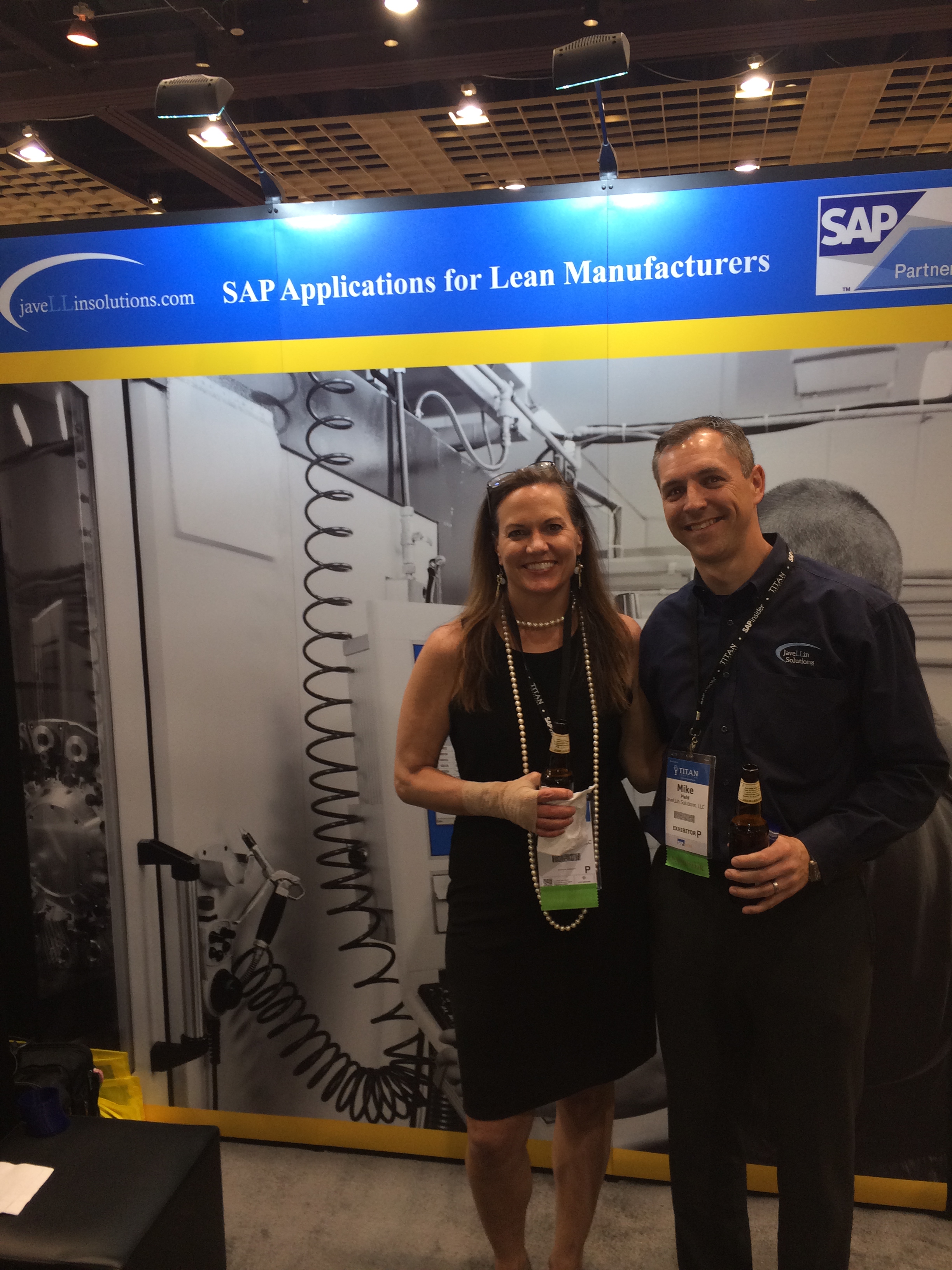
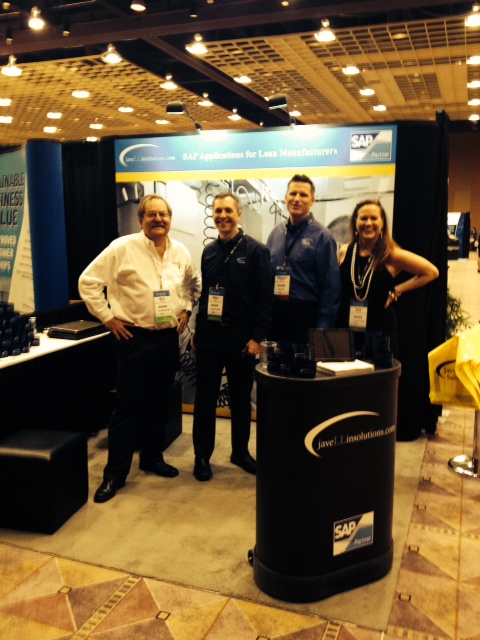
It’s amazing the difference that one year makes.  We attended the SAP MFG conference in Vegas last year and had less than stellar results.  To give you an idea of what happened, let me give you the before and after pictures..
2013-03-04 14.36.34

So, this look and feel works for a small regional show.  In general, it gives a good folksy feel. Not what I wanted to project at the big show.  Now, don’t get me wrong.  Those of you that know that me know that I’m not the flashy type.  I’m very straightforward, down to earth, and certainly a bit on the geeky side (I love my woot shirts).  But I digress.  Now, lets fast forward one year….

20140401-2 20140401-1

Notice, the distinct upgrades of the booth itself.  We have a real backdrop, a little podium, and we weren’t hiding behind a table like someone taking orders, afraid to mingle with the crowd.  Now the other thing to really notice, we have people.  A special thanks to Bob Auman, Amy Opheim and Dave Delaney who came out and helped us man the booth.  With their help, we projected an air of legitamacy.   Last year, we were 2 guys sitting at a table, this year, we were 5 people floating around, meeting, greeting and having fun.

What a difference a year makes,

Thanks for reading,

Variant Configuration – Implementing ECM

Best approach for implementing ECM on a VC model for the initial push to production.

  1. Create ECM in production client
  2. ALE from Production Client to Dev client
  3. ALE all components from Dev to Production Client using ECM.
  4. Do not maintain any components with ECM in the Dev client.
  5. Maintain all models in production using the change number, or create new change numbers for each change.

Let me go into more details.  For step 1, the ECN must exist in the target system before any ALE is processed.  This allows every object to be instantly placed under engineering change management.  The only exception will be table structures and function structures (they don’t have the option of ECM).  In addition, routings, reference operation sets, etc do not need to be placed under engineering change management, but it is highly encouraged.  This will be based on your business rules and what is commonly done in your organization.

In order to perform certain ALE steps, the change number must exist in the source system.  It does not need to be assigned to any objects, but for the ALE transaction (like BD91 or BD92) you will need to have the change number exist in both the target and the source.

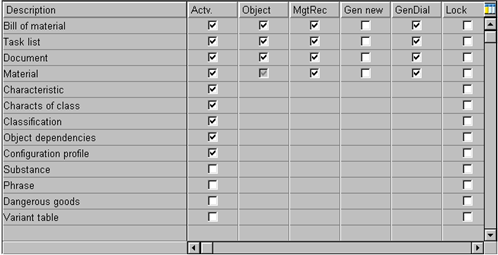
vc01

Now, to demonstrate, I used a test system to create a characteristic without ECM.  Then I’m going to make a change to the cstic and place it under ECM.  I created TEST_CSTIC and gave it values 001, 002, 003

Then I created the change number: 500000000000

Went back to TEST_CSTIC and added 004.

I then created 2 dependencies to reference this characteristic.  The first one under ECM at creation, and the second created without ECM, and then placed under ECM.  I was still able delete a value from the characteristic despite the dependency existing at 00/00/0000.  Keep in mind, the system is far more likely to give you grief when you don’t have everything under ECM control at initial creation.  There are OSS notes to be found that talk about cleaning up items without ECM, but if you can avoid the hassles, I strongly encourage it J  Happily, as of EHP4, it seems that SAP has cleaned up the integration with change numbers if they are applied after the fact, but this could quickly change once it’s connected to multiple items with mix and match ECM.

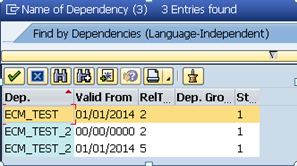
Here is something to be aware of when doing a drop down search.  You will see this behavior in searching in some transactions, like object dependencies.

vc02

Look closely at ECM_TEST_2.  It’s the same dependency, but it shows once without the change number that has the 00/00/0000 date, and again after the change number was applied.  Based on the date you enter in CU03, you can see both versions.  In previous version of SAP, this could cause issues trying to remove or delete items that existed in the 00/00/0000 date from, but from my testing in the EHP4 system, these issues appear to be resolved.

Regardless, it is still advisable to initially create all objects with ECM.  If you don’t do this with the ALE, you will need to manually make a change to every object with a change number in order to lock it down and prevent changes from occurring without ECM.

I have had to do this before and I typically use Gui Scripting to make a minor description change or add a comment.  It’s not pretty, but it can be done.


Warranty Claims – Copy Control – Assign Copy Procedures to Claim Type

Figured I better finish off these section of configuration before I get sidetracked again J  So today we’re still talking about Warranty Claims, Copying control.  Today we will go over the Assign Copy Procedures to Claim Types.

blog02-01

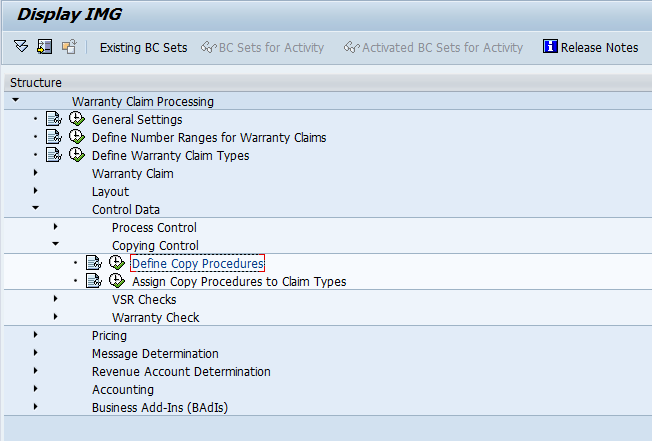
Again, go to OWTY to find this configuration, and you’ll see where to get to this menu.

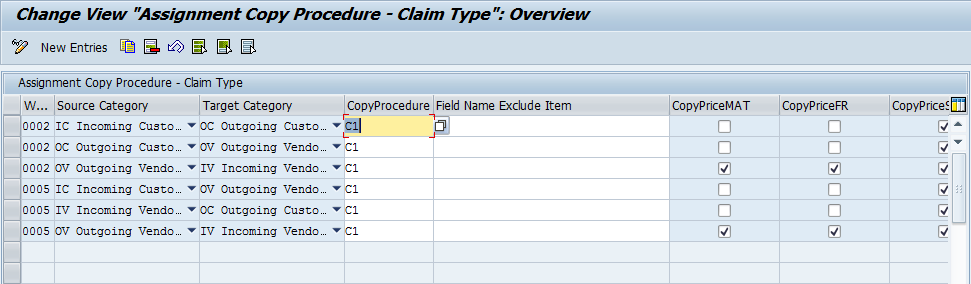
blog04-02

Beyond this, it’s pretty straightforward.  For each claim type and vervion type, you can select the copy procedure you want to use.  In addition, there are a few extra check marks:

COpyPriceMAT
CopyPriceFR
CopyPriceSUBL

You can control copying prices separately for the item types MAT, FR and SUBL.  We will talk more about these in a future post when we start talking about items.  For now, just know that you can control what prices should be copied.

That’s it, nice and easy.
Thanks for reading,

Warranty Claims – Copy Control – Define Copy Procedures

Well, with all the preparation for the SAP SCM and Logistics conference, it’s been a long time since I’ve had the opportunity to do some warranty claims stuff.  I had some time on the airplane, so what better time to give you something SAP related again.  Don’t worry, I’ll be giving you the low down on the conference soon, just as soon as I have time to figure it all out myself 🙂

Today I wanted to talk about the warranty claims, and this time around I’m going to talk about the Copying control.  Today I’ll cover the Define Copy Procedure (tomorrow I’ll do the assignment).

blog02-01

Now, as always, I like to show you where to find this.  So go to OWTY, and here you can find the menu to get here.

blog02-02

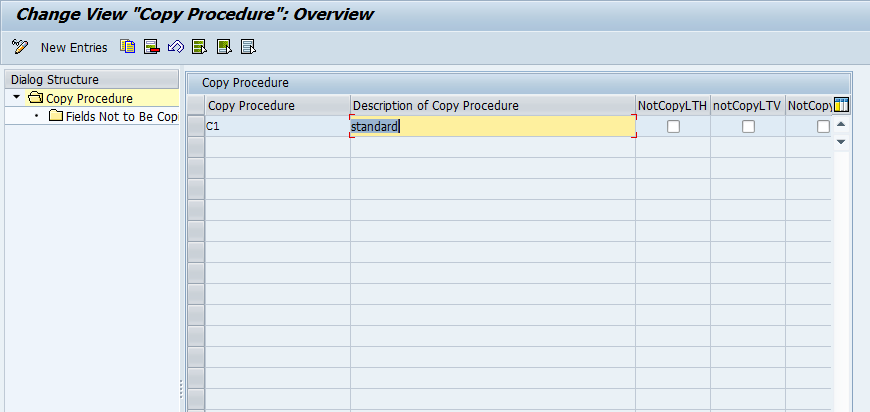
Now, we get to the screen.  The important thing to recognize is that everything is copied except for what you define here.  Being the purest that I am, I always think you should create your own version.  For today, I’ll just show you C1.

The check boxes on the initial screen work as follows:

  • NotCopyLTH = Do not Copy Long Text in Warranty Claim Header
  • NotCopyLTV = Do not Copy Long text of Warranty Claim Version
  • NotCopyLTI = Do not Copy Long Text of Warranty Claim Item

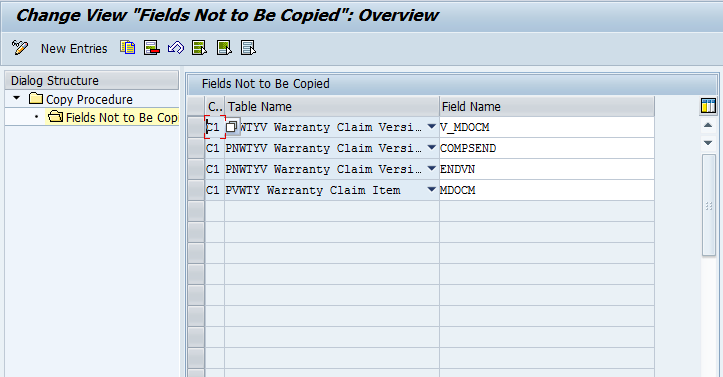
Beyond that, not much here.  Next we drill down to the fields not to be copied.

blog02-03

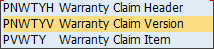
In this section, you will need one line for each field to exclude.  Notice that first you must select the table:

blog02-05

Then you can select your field.

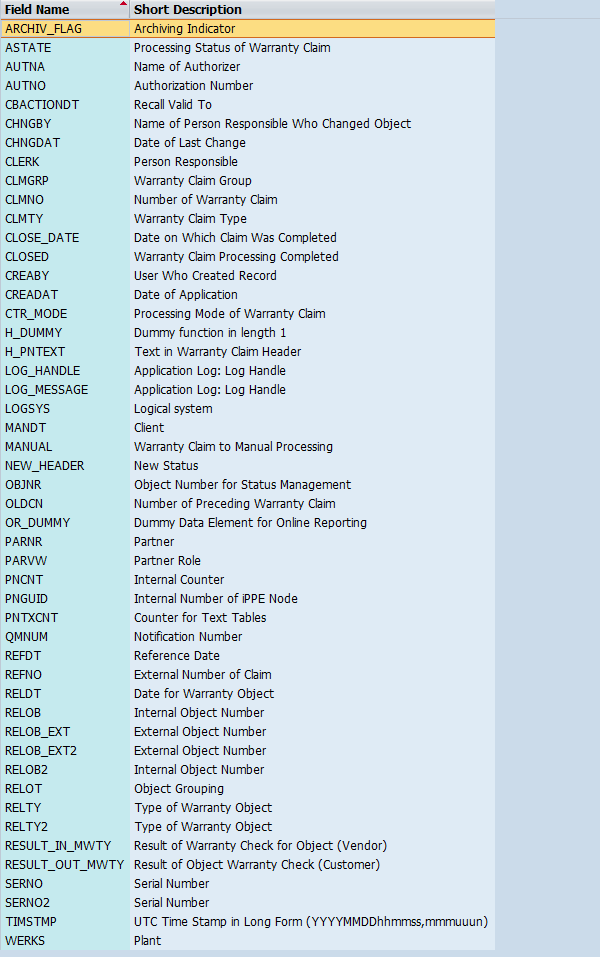
For Claim Header you get all the following fields available:

blog02-07
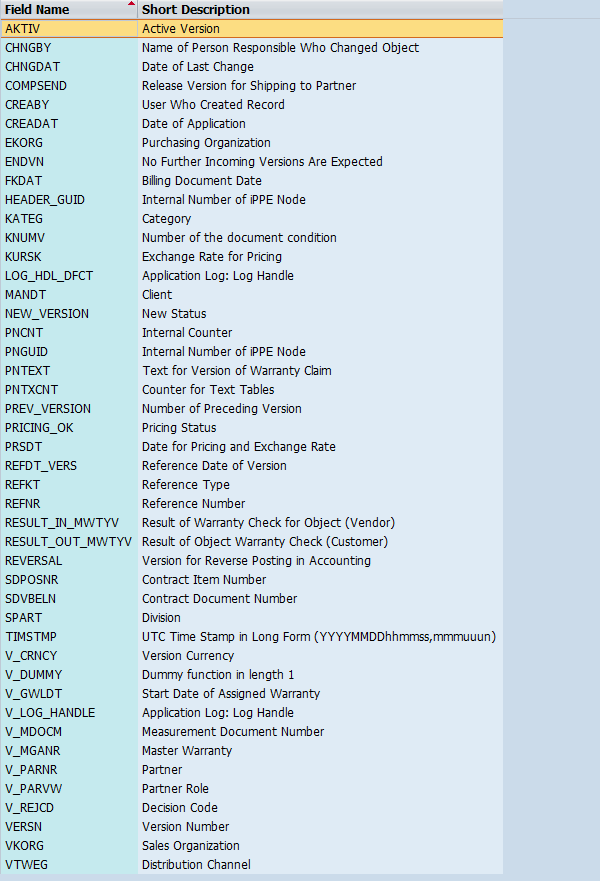
For the Claim Version you these fields:

blog02-04

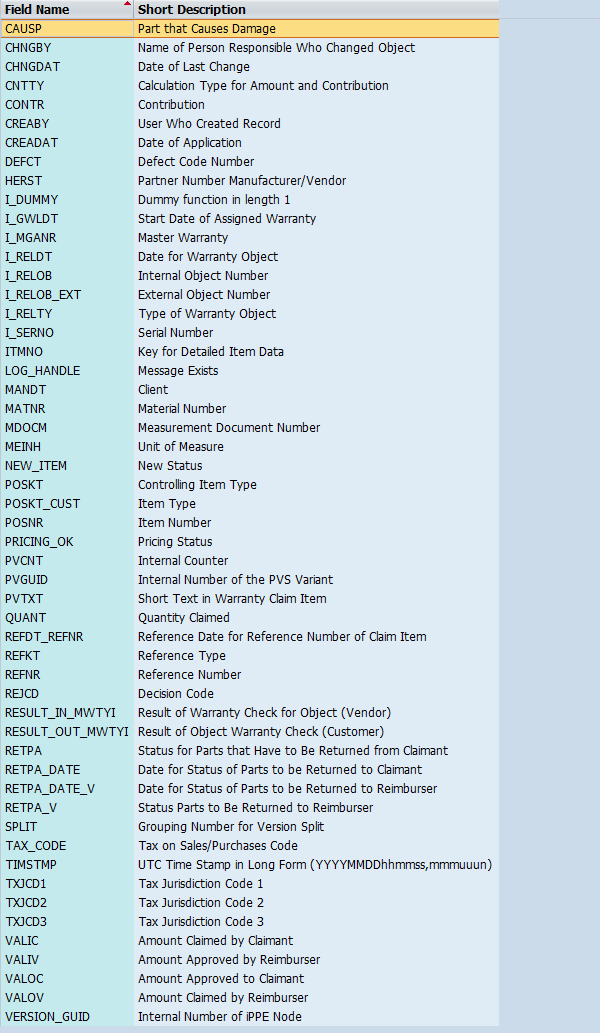
For Claim Item you get these fields:
blog02-06

Simply keep adding new entries until you have excluded everything you want from the copy function.  That’s it.
Thanks for reading,

Marketing – Using LinkedIn

Well, I recently found a new company, SBS, who specializes in using LinkedIn to better market myself and my business.  So far it’s been good .  Like everything, the true test is if we get any qualified leads of out it…  which hasn’t happened yet.  However, I have almost tripled the number of connections I have on linkedIn, and my number of views of my pages has gone up exponentially.  But the real question comes down to what does really get me.

Marketing is one of those areas that comes slowly to an engineer like myself.  While I see the value, the struggle comes with how much do I invest.  At the end of the day, it all about leads, which haven’t materialized yet.  My profile is light years ahead of where it was at, and I certainly have learned a few things about who to market myself to (I mentioned this in the past) and how to better market myself.  I’m contemplating moving up to the next level of getting a video presentation on my linkedIn profile.  My dilemma is the cost associated with this.

My question to all of you…  how much time do you spend on linkedIn?  do you ever look for software out there?  new technology?  or is it just a recruitment site?  I’d love to hear your opinions.  My marketing dollars are very valuable (because we have so few of them as a small business), and I’d love to get some feedback on your experiences.

As always, Thanks for reading,

Posts navigation

1 2 3 58 59 60 61 62 63 64 97 98 99
Scroll to top