Code Security Revisited

Well, I got some great feedback from some of my programming friends, and I wanted to pass my thoughts along, and see if anything new might be sparked.  In general, the feedback I got from everyone is that “encrypting” ABAP code is pretty much a waste of time.  If there is a developer that wants your code, they will get it.  Plus, the majority of companies out there don’t care enough to bring your code in-house, spend 80+ hours copying and pasting, creating screens, services, etc…  if they look at me in the first place, it probably means they need help, and don’t have the time to waste having their resources steal my code.  (I’m not naive, I know this could happen…  but somethings aren’t worth worrying about too much).

Then I heard back from my friend Barry, and he gave me the best advice on the topic.  He pretty much told me, if you offer something free (like my free trial), offer a scaled down version.  Provide enough functionality to showcase how good your stuff is, but don’t give away everything.  Turn off a bunch of the bells and whistles, and replace it with a message “Only available in paid version”.  This way your prospect can see it’s there…  and realize they have to pay to get everything.

In addition, I’m still looking for a good way to extract the install date of the free trial, and deactivate the software X days after.  While the code will still exist in the system, it will be a reminder that the the free offer has ended…  time to pony up some cash 🙂

Thoughts?  Thanks for reading,

The 1 year plan

Since business has been on my mind so much, here I am again.  This time it’s refining down the plan to a single year.  Now, first the time, this started to get easier for me.  It’s much easier to think in terms of a one year plan, than 10 or even 3.  why?  because for me, one year is something I personally could envision.  And that makes it even more exciting.  Again, we take the major pieces of the business and figure out where we need them to be in order to achieve the 3 year plan.  We don’t even need to think about the 10 year plan, because now we’re focused on getting to the 3 year milestones.  If we envisioned that properly, it’ll put us exactly where we need to be.

Now, the tricky part with the one plan is figuring out where you need to be…  not just where you’re going?  So for example, if you plan to hit $500,000 in sales, but you are currently at $50,000, what are you going to do to increase sales 10 times?  is it even remotely possible?  because you may completely missed reality when you did the 3 & 10 year plans.  When you stop to realistically look at what you can in a year…  well, let’s just say you  might need to rework those long term plans a bit.  It also forces you to be creative.

For example, you need to start thinking strategically.  I mentioned in a previous post that within 3 years I wanted a client independent platform for service.  Well, in order to do that, I need to my roadmap this year.  I need to figure out, at a high level, what do I want to provide.  Am I developing an entire database structure with the screens to support it?  how deep do I go into the financial side?  how much is done using web? using mobile devices? cloud?  and as soon as I started asking myself those questions, I realized there are a LOT of things I don’t know.  I don’t know much about cloud, if I don’t design in ABAP, what language should be I using to design a simple platform?  how much do I include in the process?  and on and on…

When you begin looking at the big picture, it becomes clear what you need to focus on right now.  You won’t have answers to everything, but for me, my goal became to start finding people that understood the concepts and figure out what it will take to get me there.  How about you?  what’s your one year plan look like?  Mine was a lot more learning than I expected, but it got me excited again, because I’m starting see the vision…  🙂

Thanks for reading,

Service Check up?

The other day in the shower, I came up with a pretty cool new idea.  I’m finding that I’m coming up with a lot more ideas when I step away from the day to day business of running my business 🙂  More about that in another post.  Anyway, what I realized is that my dashboard is already built in a way that can pretty easily perform a full analysis of your service business in SAP.  Well, duh!  if it didn’t, why would I expect anyone to buy it.  Now, here’s where the new part comes in.  I provide a stripped down version of the dashboard that simply extracts all of your service data.  You run it in the background, send me the files containing your data, then I analyze it, put everything into a simple report that will highlight what you do well, and areas for improvement.

Now, I’ve even taken the idea as far as having the client give me target values of where they think they are, or what constitutes good numbers vs. bad numbers.  For example, let’s say a client needs to perform an in-house repair within 36 hours.  24 hours is the target, but if it’s greater than 36, there’s an issue.  Well, with the service checkup, we can even analyze everything that is particularly bad to show you where exactly things aren’t meeting expectations.  it could be a single product, or perhaps an entire facility.

I’m still flushing out the idea, but I’d love to hear your thoughts.  Do you think this is a worthwhile endeavor?  do you know anyone that might be interested?  is there anything that I should be including in this service?  would you pay for it?

Can’t wait to hear your feedback.


The 3 Year Plan

Recently I wrote about setting up your long term vision by means of the 10 year plan.  Well, it’s great to have that long term vision, but how are you going to get there?  Well, the next step in plan has to be your three year plan.  It’s basically the same concept as the 10 year plan, but now you need to take into account what you expect to accomplish in 10 years.

Let’s explain this a little more detail.  Let’s just say that your 10 year plan has you making $5,000,000 gross revenue per year.  Now, you need to take a look at exactly where you are today.  For example, you are making $100,000 gross revenue per year.  Well, to get to $5 million, what needs to happen?  Well, first off, figure out where your gross revenue needs to be in 3 years.  Now, remember, it’s not simple math.  A lot of times your 3 year goal may end up well short of 30% of five million.  Why?  because growth isn’t a straight line.  So, a more realistic approach would be to say in 3 years, gross revenue is up to $750,000 year AND you have launched 3 new products to the market that will begin your exponential growth 🙂

Take me for example…  I have modest goals, but in order to get to those goals, I need to take my products to the next level.  What does that mean for me?  it means I need to have a platform independent offering.  Right now, everything I do is tied to SAP.  I want to move away from that limitation, and produce service products that can work alone (no huge ERP) as well as with SAP, Oracle, SalesForce.com, etc…  This change will not happen quickly, but I need to be preparing things immediately in order to make sure that 3 years from now, I have that product launched…  Get the idea?

Now the plan still needs to encompass all aspects of the business, like revenue, products, number of employees, costs, etc…  Now with a 3 year in place, it’s a little easier to guide your ship.

thanks for reading,

Code Security? Do you Trust your customers?

I was recently asked “How do you protect your code from someone just copying everything you’ve done?”  I sat there with a straight face, and said… “Well…  I don’t”.  The simple question got me to thinking about this interesting question.  Do you take efforts to make sure (or least make it difficult) no one can copy your code?

Now, if you live in most programming languages, they require a compiler, and your code is instantly safe.  But in ABAP, when you write something, it’s out there for any halfway decent programmer with some time on their hands to pirate everything you’ve painstakingly worked on.  Now of course, there is the legal recourse, disclaimers, contracts, etc.  But at the end of day, many of us are small companies, and a big legal battle is the last thing we want to deal with.  So I started googling.  The general consensus seems to be of two camps.  One, you need to trust your customer and to go through and encrypt/hide/etc your code shows bad etiquette.  Two, why bother because any 1/2 way decent programmer in ABAP could get to it anyway… and by you hiding your code, just makes it even more appealing to crack the code.

Now Google/SCN talks about adding a strange character string:  *@#@@[HOME:SAP] that if you put this in front of code it hides it “forever”.  I haven’t tried it out… but I am tempted to just to see if it works.  But at the end of the day, is it worth it?  can customers be trusted?  can you afford not to trust them?

I’d love to hear your opinions.  And as always, thanks for reading,

What’s the Value of Service Management?

This is a topic that is very near and dear to my heart.  One of the interesting things about service is that you often don’t even realize how important it is to your organization.  For example, when I first started my career, I thought I was going to be an engineer, building all these cool devices, and designing who knows what!  When I look back at those days, I realized that one of the things my engineering classes never really covered was to design things so they could be repaired (ideally, repaired easily).  It is very easy to design something on paper or your computer…  and not take into account the fact that it is nearly impossible to assemble because no one could even get their hand or a tool in place to tighten the bolts.

This is so often the case when it comes to service management.  Now, engineering is getting smarter about designs for manufacturing and service…  but often the system side is still neglected.  I see the same mentality in company after company that I consult for.  It’s the notion that they are used to “working around the system” because it’s “just the way things are”.  Being in the service world now, I realize just how painful that becomes for the service group, and more importantly, for the entire organization.  Why would it impact the whole organization?

Very simple…  whether you choose to believe it not, service is your best and easiest revenue source.  I know you are probably rolling your eyes… but hear me out.  Study after study talks about the cost of acquiring a new customer being 2 to 10 times more expensive than selling to an existing customer.  Take the low or the high estimate…  but I’d much rather cut out all the time, expense and pain of finding new customers.  This becomes especially true when all you need to do is keep your existing customers happy.  How do you keep them happy?  again, it’s a pretty straightforward formula.

1.  Make good products.  How does service have any impact on this?  well, if you’re collecting your data properly, you should have all of the market research of things you should be doing, as well as all of the quality information to tell you what you need to be doing better.  Often, this isn’t available until the product gets into the customers hands.  If you want to make the best products, you better be listening to the quality & service data.

2.  Give great service.  Want to keep your customers always buying from you, even if you are a little more expensive than the competition.  Stand behind your products and give your customers a great experience when something goes wrong.  If you can turn around a repair faster than anyone, offer a great warranty program, or provide your customer enough self service tools they will be happy to continue buying new products and coming back to you for any calibration, scheduled maintenance, etc.

I am a firm believer that service management, service processing, or whatever your organization calls it is the make or break factor in both of those points.  I’m sure there are more points…  but do you really need more than this to know that service is the key to a great organization.

Thanks for reading,

The 10 Year Plan

Well, the new Traction book I’ve been reading is forcing me to look at my endeavor as a business for the first time.  One of the first steps is to stop and decide what you want out of the business.  This is a time to be a bit realistic and a bit optimistic.  Consider this your goal.  Like every goal, it should be attainable, but don’t settle if you believe you can achieve more.  It’s strange, but something so simple is really more challenging than I expected.  When you force yourself to take an honest assessment of what you have, where your going and where you want to end up…  well, it’s eye opening.

So, how do you go about figuring out your 10 year plan?  Quite simply, just start writing.  You start with your objective.  Do you want to sell this and start again?  do you want to run this forever?   Then, you need a revenue number, it could be a sale price or a yearly .  Can you be $1,000,000 per year?  $10,000,000?  more?  Now’s the time to take a guess.  Now, you need to figure out how you’re going to get there.  What is your business?  How do you plan to evolve over the next 10 years?  Obviously, you can predict everything, but you need a game plan, a direction, a vision.  For example, I know that if I’m going to survive in the world, I need to be involved in the Internet of Things.  In what fashion, I can’t say yet…  but at least I have a vague vision 🙂

Now, fill in as much of your vision as you can.  How many employees do you have?  what is profitability?  Are you expanding into new businesses or industries?  Anything you want to happen, write it down.  Then refine it.  Based on the details are you numbers feasible?  Can you really get enough customers to make the revenue number?  Be honest…

More to come.  Thanks for reading,


Solution Manager – Approving the Download Basket

Well, finally, I learned a trick in solution manager.  I have struggled with downloading support packs and patches.  Up till now, I had to deal with the hassle of entering a support ticket, and waiting for SAP to approve it.  what a pain.  Well, now that I have a working solution manager, I can finally take care of things myself.  So, here’s the trick:

option 1

1.In the left frame switch to Operations.

2.Then, choose the tab Change Management.

3.Choose Maintenance Optimizer.

4.Choose Create New Maintenance Transaction and select the system for which you want to download the patches and confirm at the end


option 2

Login to solution manager system run tcode SE37–>Enter the function Module: /TMWFLOW/MO_UI_BASKET_AUTHORIZ and press F8 ,Leave the default values and execute again now you can see maintenance optimizer screen there you select the files and click on confirm download so that you can start downloading

Pretty easy,

Thanks for reading,

Independence Day…

As it was just the 4th of July, I can’t help thinking about the complete deception we give ourselves.  Please indulge me my occasional world outlook.  🙂  When you looked back at the fight for independence our forefathers fought to provide us.  The idea was to make us free from England.  The funny thing is that there will always be a master.  When we declared ourselves free from set of masters, it simply creates a void that will quickly be filled by the next willing master.  In our case, it was our own government, that our forefathers work so hard to keep simple, unobtrusive, and supposedly designed to protect our liberties.

The sad truth of it all, is that it seems most people long for that control.  While we claim to be the land of the free, we are quickly giving away all of our liberty in exchange for “security”.  or so we tell ourselves.   Good old Ben Franklin said it best “Those Who Sacrifice Liberty For Security Deserve Neither.”  Well, between the random wars, police actions, and conflicts we force our way into, all in the name of security, it should be painfully obvious that  security dwindles as quickly as liberty.

So please, remember that the struggle for liberty is not a republican thing, it’s not a thing…  it’s a personal thing.  So I hope you still want you liberty.  If so…  just pay attention to how easily it keeps being handed over willingly.  Just watch the news with a different perspective.  Put your political beliefs aside for a week.  If you truly look at everything in an unbiased fashion, it will incredibly obvious (and should be painful).  Step one is the realization.

Going back to one of my favorite movies, Red Pill or Blue Pill.

Thanks for reading,

Service Order – Using the Document Flow

Now in my opinion, one of the greatest things that SAP has added into the system is document flow.  this is especially true for SM.  If you’re new to SM or SD, you might not be all that familair with using document flow.  If you’ve ever visited an SD or SM document, you’ve most certainly seen this weird little icon:  .  If you plan to do anything in either of these areas of SAP, you’ll quickly realize it is your best friend.

Document flow in SAP is simply the connection to all of the preceding/follow-on documents.  In the in house service scenario, a type document flow may look something like this:
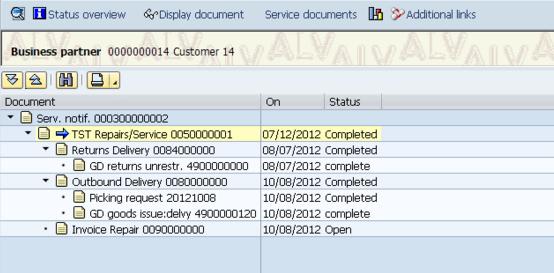
You’ll notice that in this picture I was able to see notification, the repair sales order, the inbound delivery, the outbound delivery, the invoice, and any other SD related documents.  What you also may have noticed is the distinct lack of the service order, but there is a service documents button.

Unfortunately, in the design of document flow and the table structure for capturing this, the service documents were neglected in the initial design, so the Service Documents button I believe was an afterthought.  It’s still better than nothing, and I’ll give you some tips for making the best of it.

The first big thing you need to know is, if you’re starting at an SD document (delivery, sales order etc. ) be sure to click once on the sales order (make sure it’s highlighted, and you’re good).  then press the service documents button.  This will bring up a new screen showing the service order and any of it’s related documentation.

One of the other issues I’ve encountered with document flow is the inability to see sub-service orders in the documentation.  The only way to see if there are sub service orders is to drill into the service order, and look for the structure button
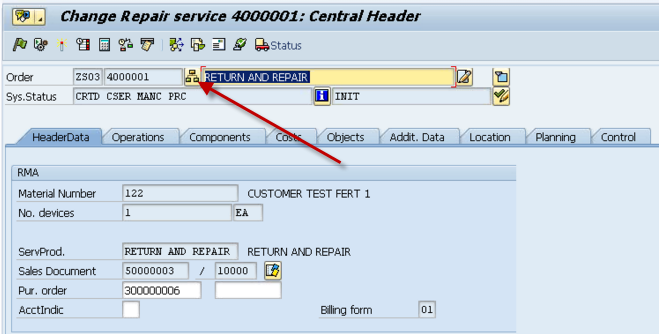
You will then need to click this button to see the sub service orders.  You can then drill into the order and see it’s individual document flow.  As a follow-on to this topic, if you have a complicated doc flow, for example…

Notification

Service Order (for quoting) – Repair Sales Order
     Service order
          Sub Service Order
          Sub Service Order
Inbound Delivery
Outbound Delivery


Now with a structure like this, you again, won’t be able to see everything depending on where in the structure you are at.  For example, if start at the service order (for quoting), you won’t be able to see the actual service order used for repair.  Instead, you’ll have to navigate to the notification, and then you’ll be able to see the structure below the notification, including the repair sales order.  The way the documents are laid out above, shows kind of how SAP structures them.  Since it is a pseudo parallel path, you have to work your way up to a common document before you can see the next path.  In this example, the notification is that common document.

There is a another big thing to remember when dealing with service.  You have to turn on the document flow for many of the items.  For example, purchase reqs, material transfer, etc. must be turned on before they will generate items in the document flow.  I HIGHLY encourage you to make sure these are turned on.  Not seeing the purchase reqs, or materials issued to a service order makes your job as a troubleshooter FAR more challenging.

Now that’s the basics of document flow, and if you’re not already using it, get familiar.  For me, it’s personally one of the best tools offered in the SD/SM module.

Thanks for reading,

Posts navigation

1 2 3 37 38 39 40 41 42 43 97 98 99
Scroll to top